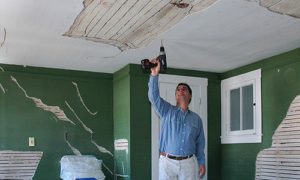
Repairing Plaster
Cracks
It is very rare to see older plaster without any cracks, and there are those
of us that find cracks part of plaster's aesthetic character and charm - love
plaster, love cracks. Cracking, however, can also be serious and lead to further
plaster damage if not taken care of. Cracks occur for a variety of reasons,
many of which are simply the natural reactions of plaster compounds and building
materials. Climate and temperature changes, building settling and moving over
time, weight loads, chimney movement and environmental stresses (heavy traffic,
nearby trains, construction blasting) all contribute to plaster cracking. Cracking
is further exacerbated by any structural disturbances or repairs to a building
(foundation work, sill repair), leaving a building unheated during the winter,
deteriorating framing and timber (rotting sills, weak floors and joists, insufficient
framing), or water leaks. Some or any of these conditions are usually present
in older homes and buildings.
As a caretaker of an older building, it is a good idea to learn some basics
of plaster repair. Cracks are a good place to start with and will provide a
foundation for other repairs such as patching and skimming. Cracks can be repaired,
and if done correctly you will have long-lasting to permanent results. Using
spackling, taping, and/or repainting are quick fixes that usually result in
a crack coming back. For a sound repair to any crack, the plaster on each side
of it must be stopped from moving or shifting, and the substrate material (wood
or rock lath) must be solid and secure with no bouncing. Push gently on the
plaster on each side of a crack to test for movement. If it gives, or has delaminated
from its substrate, more than 1/8" than further repairs such as reattachment
is necessary. If the substrate is week, some sort of stabilization is necessary.
Assuming we have a crack in stable plaster in need of repair, we find our crack
repair method very successful.
Printable Version 'Crack Repair - Illustrated'