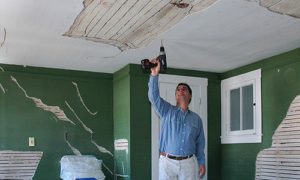
Cures for Calcimine Ceilings
If patches of peeling paint on a ceiling or flakes of paint chips littering
the room is a familiar site in your old house, your ceiling likely has a past
that includes calcimine paint. Used throughout the 19th and into the early
third of the 20th century, calcimine paint was a very popular and economical
solution to give interior surfaces a fresh coating. Also referred to as
kalsomine or distemper paint, it was a dried calcium carbonate product that,
mixed with water and sometimes pigments and glue, formed an opaque, easy to use
and fast-drying coating for walls and ceilings. These were the days of heating
with coal and wood stoves, so walls and ceilings stained with soot quickly and
calcimine was a quick and inexpensive cover-up during spring cleaning. Another
aspect of its appeal is that it could be used immediately over new plaster as a
coating. The plasters used during these times took anywhere from 30-60 days to
fully "season" to the point that the PH-levels in the plaster
compound would accept oil-based paint. Otherwise, the paint would become
blotchy, blister and peel off as the curing plaster reacted with the oils in
the paint. So calcimine provided a soft look to the stark plaster surface, and
allowed builders and homeowners to "finish" their project
immediately.

Being essentially chalk, the water-based mixture of calcimine paint
contained minimal binders and glues for adhesion. Herein lies the problem for
those of us dealing with peeling paint now, because this lack of active binder
chemicals discourages modern paints from adhering. Over time, any paint
coatings over a calcimine base will fail, chipping and peeling away modern
paint coverings have nothing to "stick" to. Also, it is a very soft
coating and all of today's paint products are harder by comparison. A harder
and stronger product cannot be layered successfully over a softer and lighter
product because its surface tension will cause it to pull away. Environmental
and climate changes (temperature shifts, unheated rooms during winter, moisture
and humidity) also accelerate the delamination process significantly. The
consequences of each of these scenarios are lots of peeling and large flakes of
paint simply falling away from the wall or ceiling surface.
There are no easy or quick fix solutions to removing calcimine coatings.
To achieve a smooth and long-lasting painted surface, as much of the calcimine
as possible must be removed for any paint to adhere. This is a messy and time-consuming
project, but well worth the effort. Another approach involves "locking"
the calcimine onto the surface by sealing it with calcimine-coater or an oil-based
primer. Both these approaches have advantages depending on your particular
situation and energy level for the project. It really depends on if you are
trying to cover over a problem or get rid of the problem, and how smooth you
desire your finished ceiling to be. Simply repainting the surface will not,
unfortunately, make your problems go away. You also do not want to begin to
sandwich oil-latex-oil paints because they 'move' and react to environmental
changes differently so this will only worsen your peeling problem. We will
describe the two approaches we prefer when dealing with that determined-to-peel
calcimine.