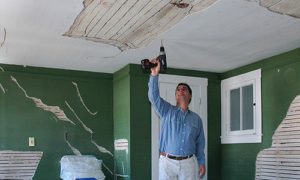
I have been struggling with cracking (not sagging) plaster ceilings
for 15 years. We have redone the roof, put vents in the soffit, installed
an attic fan, and re-spackled and repainted many times to no avail.
Why do the cracks keep returning?
Cracks always indicate movement of a building and/or its materials.
Cracks can be repaired, but must be done so correctly to have long lasting
results. Using spackling infill, fiberglass tape, or repainting are
not long-term solutions to cracks. To prevent a crack from coming back,
the crack must be dug out down to the substrate (wood, rock or wire
lath, blueboard), the plaster surrounding the crack must be secured
so it does not move or shift, and the substrate material must be solid
and secure with no bouncing.
Cracking will almost always occur in older plaster - to some degree
it is part of its natural, aesthetic character (love plaster, love its
cracks). However, cracking can also be serious and lead to further plaster
damage if not taken care of. Plaster will crack as a result of the organic
materials that are used, climate and temperature changes, building settling
and moving over time, and other environmental stresses (heavy traffic,
nearby trains, construction blasting, etc.), or perhaps the plaster
coat is too thin. Cracking is exacerbated by structural repairs to a
building (foundation work, sill repair), leaving a building unheated
during the winter, and deteriorating framing and timber (rotting sills,
weak floors and juices, insufficient framing).
The severity, position and direction of a crack leave us visual clues
about what is going on with a building. Hairline cracks are very common
in older plaster. Horizontal hairline cracking (running with the wood
lath) is most likely an original crack from the time the plaster was
applied. As the wood responded to the water content of plaster by expanding
and drying, and the plaster shrunk during the setting up process, it
would naturally crack along the lath.
Vertical hairline cracking indicates the building is settling (naturally
or otherwise), damaged or rotting framing and timber (sills), chimney
movement, or wood warping somewhere within the structure and supporting
systems.
See Repairing Plaster Cracks in our Restorer's Notebook area.
Back to top
Why
should we choose plaster over drywall?
This is a very
common question we receive, and certainly logical since budgetary concerns
affect many decisions during a construction project. There are many
reasons, both practical and aesthetic, to go with a plaster system.
Plaster is a far
more durable surface than drywall. A quality plaster system will last
100 years and still look great - no unsightly seams and nail pops like
drywall. Plaster will resists abrasions and the wear and tear of the
family household or work setting, and will not dent when banged into
as a drywall surface will. Plaster is very sound-reflective, offering
a clear, crisp sound within the room, while not transmitting the sound
as readily into adjoining rooms. Plaster is also far more flame and
fire resistant than drywall.
On the aesthetic
side of things, the hand-tooled look of plaster provides more ambiance
and depth to the surfaces within your rooms, versus the flat, sterility
of drywall. Plaster is more adaptable to shaping and architectural details
- there are no unsightly seams, corners are clean, and adjointments
can be angular or a soft, sweeping curve.
We encourage you
to consider introducing the richness, warmth and comfort of a fine quality
plaster finish to your living environment!
Back to top
Why is the paint peeling off my ceilings in big chunks?
This is a familiar
problem in many older homes and buildings. Calcimine paint was most
likely used at one time and is preventing new paint from "sticking"
to the surface. A popular and economic solution to giving ceilings a
fresh coating in the early part of the century, this chalk-based product
does not allow for new paint coverings to adhere.
Calcimine is more
accurately described as a coating - not actually a paint at all by today's
definitions due to its minimal binders. Herein lies the problem. Unfortunately,
due to its chalky nature, it does not allow for modern paint coverings
to adhere since they have nothing to "stick" to. The consequences
are lots of peeling and large flakes of paint simply falling away from
the wall or ceiling surface - a familiar scene in many older homes and
buildings.
Look for our article
on 'Dealing with Your Peeling Ceiling' in Old
House Journal magazine.
More about Calcime..
Back to top
Do Plaster buttons work?
Well, the answer
is "yes and no." Plaster buttons are designed for securing
plaster back onto the lath, and can help avoid a more complicated reattachment
process that a professional plasterer would use. They appear to be a
much simpler and quicker solution to plaster delamination, unfortunately,
what seems too good to be true is in most cases. The downside
is that plaster buttons only secure an area about the size of the washer-head
- about a 1" area, and only work when there is no residue and silt
build up between the plaster and lath (rare, rare circumstance) because
they must make it through the plaster with enough depth into the lath
to form a strong hold. The injection reattachment process that we use
uses a glue adhesive process, and spreads the glue out 2"-3"
securing a far greater area with a much smaller hole. Buttons can also
crack and shatter the plaster more around them if they are screwed in
too tightly. Finally, this large washer then needs to be skimmed over
with 2-3 coats of something to hide it, bringing the surface out further
for more work during the blending and finishing stages. There are some
instances where a full skimming is planned and delamination is minimal,
making them a viable reattachment option.
Look for our article,
"Hanging by a Hair - Techniques for Reattaching Plaster,"
featured in the January/February 2001 issue of Old
House Journal
Back to top
ASK
A QUESTION